
Research from the University College London found that uncertainty is often more stressful than a known bad outcome. In other words, your brain would rather know that something will go wrong than have no idea what will happen.
That tells you a lot about why the unknown feels so heavy.
But here is what I want you to sit with before we go any further. The unknown is not your enemy. In most cases, it is the exact space where growth, breakthrough, and God’s best work actually happen.
In this guide, I’ve put together three result driven approaches to overcome the fear of the unknown: Christian faith, mental health science, and practical productivity habits.
Together, they give you a complete toolkit for walking through uncertainty without being paralyzed by it.
Let’s get into it.
Table of Contents
What Is the Fear of the Unknown?
Psychologists call it Intolerance of Uncertainty, or IU for short.
It refers to the difficulty a person has tolerating situations where outcomes are unclear or unpredictable. It is different from general worry. This fear is specifically tied to ambiguity.
Spiritually, this kind of fear has been around since the beginning. Even Moses, David, Elijah, and Esther wrestled with stepping into situations they could not fully see. So if you struggle with this, you are in solid company.
What Causes Fear of the Unknown?
Understanding the root helps you deal with the branch. Here are the most common reasons people struggle here:
The Brain’s Threat System
Your amygdala, the part of the brain that monitors danger, fires up when it cannot predict an outcome. It treats uncertainty the same way it treats physical danger. This is a survival mechanism, but in modern life, it often creates more anxiety than protection.
Past Painful Experiences
If the unknown has hurt you before, your nervous system learns to brace for it. A sudden job loss, a relationship that ended without warning, a betrayal you did not see coming. These experiences wire your brain to expect pain when things feel unsettled.
A Controlled Upbringing
Environments that punish failure or discourage risk-taking often produce adults who fear new territory. This is not about blame. It is about recognizing patterns so you can start to rewrite them.
Perfectionism and the Need for Control
Perfectionists need to know the outcome before they take the first step. When they cannot have that certainty, the unknown feels threatening. Proverbs 3:5 puts it directly: “Trust in the Lord with all your heart and lean not on your own understanding.”
Chronic Doomscrolling
Studies show that people who follow the news closely report significantly higher anxiety levels than those who intentionally limit their media consumption. Constant exposure to worst-case news trains your mind to expect disaster.
Low Self-Efficacy
If you do not believe you can handle whatever comes, the unknown feels enormous. Building confidence in your ability to cope is one of the most practical things you can do to reduce this fear.
10 Ways to Overcome the Fear of the Unknown
Here are effective ways to overcome your fear of uncertainty:
1. Anchor Yourself in God’s Sovereignty
Start here. The unknown to you is never unknown to God.
He is not surprised by what is ahead of you. Isaiah 46:10 says that He declares the end from the beginning. Jeremiah 29:11 confirms that His plans for you are good, not harmful.
A practical way to live this out is through a daily surrender prayer. Each morning, write down what is unsettling you and then intentionally hand it over. Not as a one-time ritual, but as a daily act of trust.
You do not need to see the full staircase. You just need to trust the One who built it.
2. Rewire Your Thinking with Cognitive Reframing
Your thoughts are not facts. They are drafts. And you have the ability to rewrite them.
Cognitive reframing is a technique from Cognitive Behavioral Therapy (CBT) that teaches you to challenge unhelpful thought patterns and replace them with more balanced ones.
Instead of defaulting to “What if this goes wrong?”, you train yourself to also ask “What if this goes right?”
Try this practical exercise. Take a journal and split a page in two columns. On the left, write every fear you have about an uncertain situation. On the right, write an equally realistic positive outcome. Do this every day for two weeks and watch how your brain begins to shift.
3. Meditate on God’s Track Record
Fear loses its grip when you remember what God has already done.
The Israelites in Exodus 16 did not know what tomorrow’s food would look like, but manna showed up every morning. Not a week’s supply at once. Just enough for today.
Start an Ebenezer Journal. An Ebenezer, in Scripture, is a stone of remembrance.
Write down every answered prayer, every door God opened, every moment He showed up when you did not know how things would work out. Read that list when fear tries to convince you that this time will be different.
4. Use the Physiological Sigh to Calm Your Nervous System
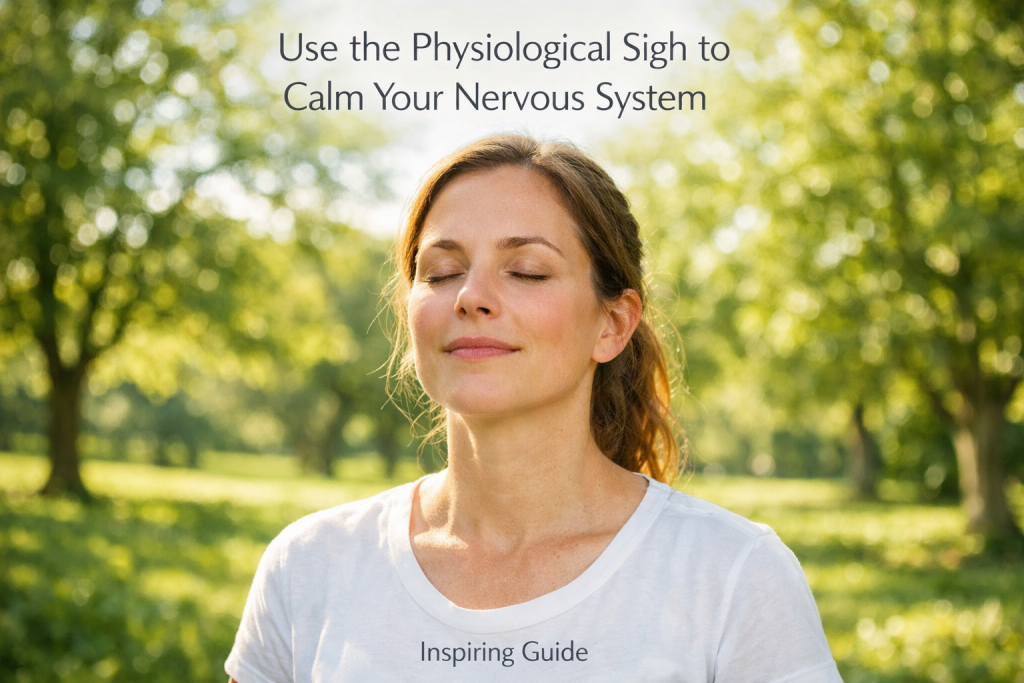
Before you can think your way out of fear, sometimes you need to breathe your way through it.
Stanford research has researched a breathing technique called the physiological sigh. It works like this: take two short inhales through your nose, followed by one long exhale through your mouth.
This activates the parasympathetic nervous system and brings your body out of its stress response faster than a single deep breath.
Use it before a big decision, during an anxious episode, or any time uncertainty spikes. You can also pair it with a Scripture declaration spoken out loud immediately after.
5. Break the Unknown into Micro-Knowns
Fear of the unknown grows when you stare at the whole mountain. It shrinks when you focus on the next step.
The productivity concept of minimum viable clarity says you do not need to know everything. You just need enough clarity for your next move.
Here is a simple tool called the 3 Next Actions method:
- Write down the uncertain situation you are facing.
- Identify three small, concrete actions you CAN take in the next 48 hours.
- Take the first one within 24 hours.
Use Notion, Trello, or even a paper list to track these. Action creates momentum. Momentum creates confidence. And confidence makes the unknown feel a lot less terrifying.
6. Find Community and Speak It Out Loud
The act of naming what we are afraid of in the presence of safe people, is one of the most healing things a human being can do.
Fear grows in silence and shrinks in community.
Ecclesiastes 4:9-10 says that two are better than one, because when one falls, the other can lift them up.
Find a trusted friend, an accountability partner, or a small group where you can name your fears out loud. The fear you speak into the light loses the power it had in the dark.
7. Grow a Growth Mindset Toward Uncertainty
Dr. Carol Dweck’s research at Stanford introduced the world to the growth mindset concept. People with a growth mindset do not see failure or uncertainty as a verdict. They see it as a classroom.
Here is a practical reframe. Think of three times in your past when you stepped into the unknown and it shaped you in a meaningful way. A hard season that grew your patience. A scary decision that opened a door you never expected. Write them down.
Let them remind you that the unknown has served you before, and it can serve you again.
8. Fast, Pray, and Seek Direction
When clarity is hard to find, intentional spiritual disciplines help open the channel for it.
Jesus in the Garden of Gethsemane faced what no human before or after has faced, and He responded with prayer.
Luke 22:42 shows us a Man in full submission even when the path ahead was painful and unclear. Consider setting aside a day for focused fasting and prayer around a specific fear or decision you are carrying.
Come with your list of fears, your Scriptures, and an open hand. Then listen for peace, for Scripture, and for wise counsel from people you trust. Proverbs 11:14 says that in the multitude of counselors, there is safety.
9. Set Limits on Doomscrolling and Information Overload
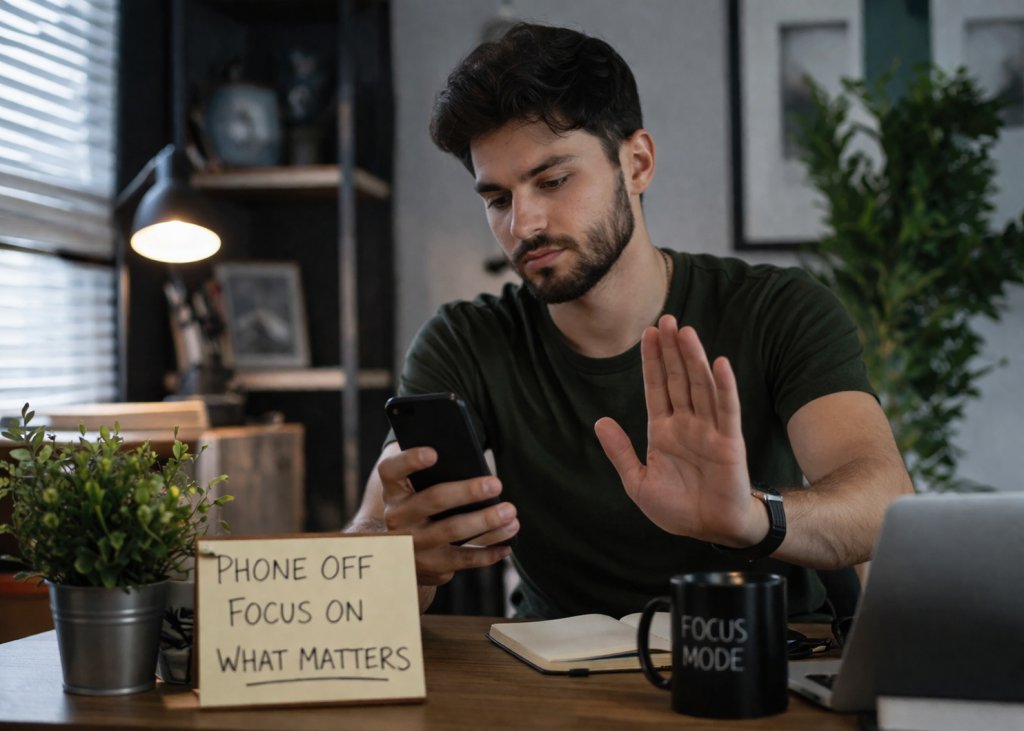
Your phone is not neutral. Every time you open it and consume unfiltered crisis content, you are feeding the part of your brain that believes the world is more dangerous than it is.
A 2020 study published in Health Communication found that excessive COVID-19 news consumption was directly linked to increased anxiety and worse mental health outcomes.
The same principle applies to any news cycle built on fear. Start with these practical boundaries:
- No phone for the first 30 minutes after you wake up. Start with Scripture or quiet instead.
- Set app time limits on news and social media apps.
- Do a weekly screen time audit and adjust intentionally.
Psalm 46:10 is not just poetic. “Be still and know that I am God.” Stillness is a spiritual discipline that protects your mind.
10. Take Action Before You Feel Ready
Courage is not the absence of fear. It is the decision to move in spite of it. James 2:17 says that faith without works is dead. You cannot pray your way into motion and then stay still. Faith moves.
Start impossibly small. James Clear’s 2-Minute Rule from Atomic Habits says that if an action takes less than two minutes, do it now. Break your next step into something so small that resistance crumbles.
Abraham left his homeland without knowing where he was going (Hebrews 11:8). Esther walked into the king’s court knowing it could cost her life. Moses stretched out a staff over the Red Sea before it parted.
None of them had certainty. All of them had movement. The road appears when you start walking. Not before.
Frequently Asked Questions
What is the fear of the unknown called?
Psychologists call it Intolerance of Uncertainty (IU). In severe cases, it may appear as a symptom of Generalized Anxiety Disorder (GAD). It is not a character flaw. It is a recognized psychological experience that responds well to the right tools.
Is fear of the unknown a sin?
The Bible never calls fear itself a sin. It does, however, consistently invite us to choose trust over anxiety. The phrase “fear not” appears over 365 times in Scripture, which tells you how much God understands this human struggle. The invitation is not to feel no fear but to bring that fear to Him.
How does fear of the unknown affect mental health?
Chronic uncertainty intolerance is linked to anxiety disorders, depression, decision paralysis, and burnout. It raises cortisol levels, disrupts sleep, and weakens the immune system over time. If your fear has become debilitating, speaking with a licensed therapist or Christian counselor is a wise and healthy step.
Can fear of the unknown ever be useful?
Yes.
A healthy degree of caution about the unknown protects you from reckless decisions. The goal is not to eliminate the feeling but to stop letting it make decisions for you. Let it inform your preparation, not block your movement.
What are some quick ways to calm fear of the unknown in the moment?
- Practice the physiological sigh: double inhale through the nose, one long exhale through the mouth.
- Speak a Scripture declaration out loud.
- Write down your fear and three possible positive outcomes.
- Call or text a trusted friend.
- Take one small action immediately. Movement breaks paralysis every time.
Final Thoughts on Ways to Overcome the Fear of the Unknown
The fear of the unknown does not make you weak. It makes you human. But it does not have the last word.
You now know why this fear shows up, where it comes from, and exactly what to do about it, from a faith perspective, a mental health angle, and a practical habits approach.
Start with one strategy today. Not ten. One. Build from there.
And remember what 2 Timothy 1:7 says plainly: God has not given you a spirit of fear. He has given you power, love, and a sound mind.
Which of these 10 steps are you going to try first? Drop your answer in the comments below. And if this helped you, share it with someone who needs a little courage today.

I’m Happiness Hassan, the founder of Inspiring Guide—A personal development blog that empowers you to become the best version of yourself!
Meet the Author
Happiness is also an SEO content writer and strategist with over 7 years of experience helping brands boost visibility, engagement, and sales.
Whether it’s keyword research, crafting content, or fine-tuning on-page and off-page strategies, I’ve got you covered. My goal is beyond driving traffic but making your users experience a win-win for everyone!
On the coaching side, I’ve trained countless writers to turn their passion into profitable SEO careers. I help them navigate the SEO path, standing out in even the toughest niches and cashing in on their skills.
When I’m not geeking out over SEO, you’ll find me deep in the world of self-development. As a dedicated student of continuous growth, I write about my growth journey, sharing insights to help others unlock their potential. So, if you’re looking for a little push to become your best self, stick around—I’ve got you covered!




0 Comments