
Struggling with doom scrolling? Discover 8 proven tips on how to stop doom scrolling, improve your focus, reduce anxiety, and reclaim your time and mental clarity.
You open your phone to check one notification.
A few minutes later, you are deep into another heartbreaking headline, another stressful video, another endless thread of negativity. Before you know it, an hour is gone. Your mood feels heavier, your mind feels crowded, and the task you planned to do remains untouched.
That is the reality of doom scrolling.
Many of us do it without even realizing it. What starts as just checking updates slowly turns into an exhausting cycle of consuming bad news, toxic content, and emotionally draining information online.
The scary part is that doom scrolling does not only waste time. It quietly steals focus, mental clarity, productivity, sleep, and peace of mind.
A report from DataReportal shows that the average person spends over 2 hours daily on social media. For many people, a huge part of that time is spent doom scrolling through endless feeds filled with fear, outrage, comparison, and anxiety.
If you can relate to that feeling, this article is for you.
In this guide, we will talk honestly about doom scrolling, why it is addictive, how it affects your attention span, and most importantly, how to stop doom scrolling and reclaim your focus.
Table of Contents
What Is Doom Scrolling?
Doom scrolling refers to the habit of continuously consuming negative or stressful content online for long periods.
It usually happens on social media platforms like Instagram, TikTok, X, Facebook, YouTube, and even news apps.
You may start by searching for one update, but the endless stream of alarming headlines, emotional videos, trending controversies, and fear-driven stories keeps pulling you deeper.
The more you scroll, the harder it becomes to stop.
That is why doom scrolling often feels automatic.
You tell yourself, “Just one more post.”
Then one more becomes thirty more.
Psychologists explain that the brain naturally pays more attention to negative information because humans are wired for survival. Bad news feels urgent. Our brain wants to stay alert.
Social media algorithms understand this very well.
That is why controversial, emotional, and fear-driven content spreads quickly online. It keeps users engaged longer.
Unfortunately, constant doom scrolling can leave people emotionally overwhelmed without even realizing it.
Why Doom Scrolling Is So Addictive
One reason doom scrolling feels difficult to stop is because social media platforms are designed to keep users engaged.
Infinite scrolling means there is always another post waiting:
- Another shocking headline.
- Another emotional video.
- Another comment section.
Your brain keeps searching for something new.
According to a study published by the National Library of Medicine, excessive social media use is strongly linked to anxiety, reduced concentration, and emotional fatigue.
Doom scrolling also creates a cycle of temporary emotional stimulation.
Even when the content makes you anxious, your brain still craves the constant updates.
That is why many people pick up their phones repeatedly throughout the day without any clear reason.
Another major trigger is fear of missing out.
People feel pressured to stay updated on everything happening online. The result is information overload. Instead of feeling informed, you feel mentally exhausted.
Signs You Are Doom Scrolling Too Much
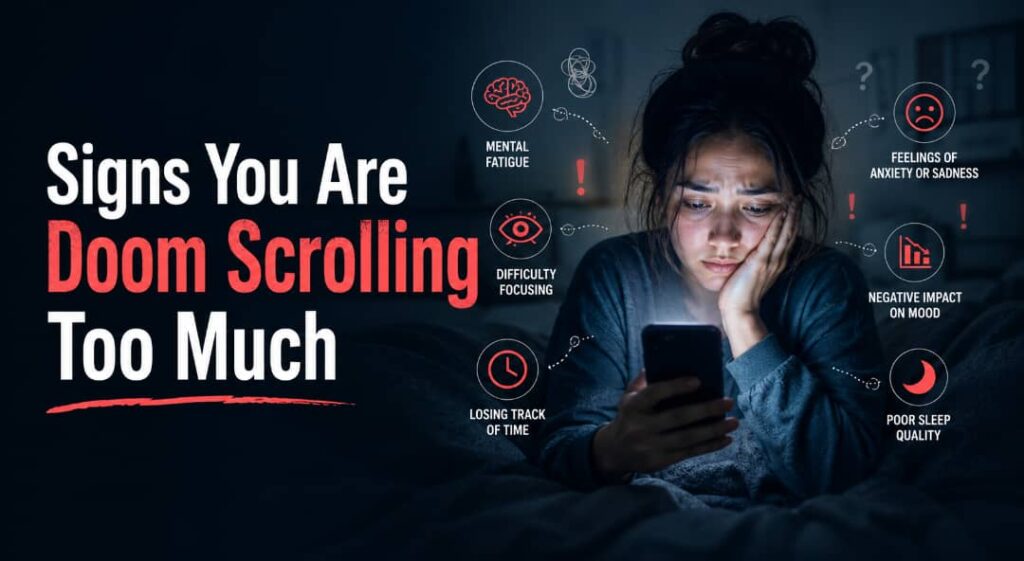
Sometimes doom scrolling becomes so normal that people fail to notice how much it affects them.
Here are some common signs:
- You Lose Track of Time Online: You open one app for five minutes and suddenly realize an hour has passed.
- You Feel Mentally Drained After Scrolling: Instead of feeling relaxed, you feel anxious, overwhelmed, irritated, or emotionally exhausted.
- Your Attention Span Feels Worse: You struggle to focus on work, reading, studying, or meaningful conversations.
- You Check Your Phone Immediately After Waking Up: Many people begin doom scrolling before even leaving bed.
- You Struggle to Sleep at Night: Late-night doom scrolling overstimulates the brain and makes quality sleep harder.
- You Constantly Refresh Social Media Apps: Even during important tasks, your mind keeps pulling you back to your phone.
If any of these signs sound familiar, you are not alone.
Doom scrolling has become one of the biggest modern distractions affecting productivity and mental wellness.
The Hidden Effects of Doom Scrolling
Many people think doom scrolling is harmless because it happens online.
But its effects can quietly impact daily life in serious ways.
Reduced Productivity
Doom scrolling destroys deep focus.
Every interruption weakens concentration.
Research from the University of California found that after an interruption, it can take over 20 minutes to fully regain focus on a task.
Now imagine checking your phone repeatedly throughout the day.
That constant switching makes it harder to complete meaningful work.
Increased Anxiety and Stress
When your brain constantly consumes alarming information, your body remains mentally alert.
Too much doom scrolling can increase stress levels and emotional tension.
Poor Sleep Quality
Scrolling late at night affects melatonin production because of screen exposure.
It also overstimulates the mind.
That is why many people feel tired even after spending hours in bed.
Difficulty Enjoying Real Life
Doom scrolling can make people emotionally disconnected from their surroundings.
Instead of being present, the mind stays trapped online.
You may spend time with family while still mentally attached to your phone.
Shortened Attention Span
One of the biggest effects of doom scrolling is reduced attention span.
Your brain becomes used to fast, short bursts of stimulation.
As a result, long reading sessions, focused work, or deep thinking start feeling difficult.
How to Stop Doom Scrolling and Reclaim Your Focus

Breaking the doom scrolling habit does not happen overnight.
But small intentional changes can make a huge difference.
Here are eight practical ways to stop doom scrolling and regain control of your attention.
1. Set Time Limits for Social Media
One of the simplest ways to stop doom scrolling is by creating boundaries around your screen time.
Most smartphones now include digital wellbeing tools that track app usage.
Use them.
Set daily limits for social media apps.
You may be surprised to discover how much time disappears into endless scrolling. Even reducing your daily social media use by 30 minutes can improve focus and productivity.
Another helpful strategy is creating intentional scrolling windows.
For example:
- Check social media only during lunch break
- Avoid random scrolling during work hours
- Stay offline one hour before bed
Boundaries help you use technology intentionally instead of automatically.
2. Remove Triggers That Lead to Doom Scrolling
Sometimes the smallest triggers keep the doom scrolling habit alive.
Every notification creates an urge to check your phone.
One notification becomes ten minutes of scrolling. Then ten minutes becomes an hour. To stop doom scrolling, reduce unnecessary triggers.
Here are simple changes that help:
- Turn off non-essential notifications
- Remove social media apps from your home screen
- Log out after each session
- Keep your phone away while working
- Use grayscale mode to reduce screen stimulation
The goal is to make mindless scrolling less convenient.
3. Replace Doom Scrolling With Meaningful Activities
One mistake many people make is trying to quit doom scrolling without replacing it.
Habits rarely disappear without replacement.
Your brain still wants stimulation. The key is choosing healthier alternatives.
Instead of reaching for your phone every free moment, try:
- Reading books
- Journaling
- Exercising
- Taking walks
- Listening to podcasts
- Spending time outdoors
- Learning a new skill
- Having real conversations
Personally, I noticed that whenever I spent more time writing, reading, or reflecting offline, my urge for doom scrolling reduced naturally.
Meaningful activities create healthier forms of mental engagement.
4. Avoid Your Phone First Thing in the Morning
How you start your morning shapes your mental state for the rest of the day.
Unfortunately, many people begin their mornings with doom scrolling.
Before brushing their teeth or saying a prayer, they are already consuming stressful updates online.
That instantly floods the mind with distraction.
Instead of starting your day with chaos, create a calm morning routine.
You can:
- Stretch
- Pray or meditate
- Read a book
- Journal your thoughts
- Plan your day
- Drink water quietly before touching your phone
Protecting your mornings can significantly reduce doom scrolling habits.
5. Create Tech-Free Zones and Hours

Not every moment needs a screen.
One powerful way to stop doom scrolling is by creating spaces where phones are not allowed.
For example:
- No phones during meals
- No scrolling during conversations
- No devices in the bedroom
- Screen-free evenings once or twice weekly
These small habits help you reconnect with real life:
- You become more present.
- You notice conversations more.
- You think more clearly.
- You sleep better too.
According to the Sleep Foundation, reducing nighttime screen exposure improves sleep quality and mental wellness.
6. Curate Your Social Media Feed
Not all content deserves access to your mind.
One major reason doom scrolling feels emotionally exhausting is because many feeds are filled with negativity, outrage, comparison, and fear.
You have the right to protect your digital environment:
- Unfollow accounts that constantly drain your energy.
- Mute pages that trigger anxiety.
- Reduce exposure to toxic discussions.
Instead, follow content that inspires growth, creativity, learning, positivity, and balance.
Your social media feed should support your mental health, not destroy it.
Remember this:
The algorithm learns from what you consume.
The more negative content you engage with, the more similar content you will keep seeing.
7. Practice Mindfulness and Self-Awareness
Sometimes doom scrolling is not really about information.
Sometimes it is an emotional escape.
People often scroll excessively when they feel stressed, lonely, anxious, bored, or overwhelmed.
That is why self-awareness matters.
Before opening social media, pause briefly and ask yourself:
- Why am I reaching for my phone right now?
- Am I bored?
- Am I anxious?
- Am I avoiding something important?
- Is this helping me feel better?
Mindfulness creates awareness around automatic behavior.
The more aware you become, the easier it gets to stop doom scrolling intentionally.
Simple mindfulness practices like deep breathing, meditation, journaling, or quiet reflection can help calm mental overstimulation.
8. Rebuild Your Attention Span Slowly
One hidden effect of doom scrolling is reduced concentration.
Many people now struggle to focus deeply for long periods. The good news is that attention span can improve with practice.
Start small:
- Read for ten minutes without touching your phone.
- Work in focused blocks.
- Practice single-tasking instead of multitasking.
- Spend time offline regularly.
- Over time, your brain slowly adjusts.
- Focus becomes easier again.
- You begin thinking more clearly.
- You feel mentally calmer.
Learning how to stop doom scrolling is really about retraining your attention.
Healthy Habits That Prevent Doom Scrolling
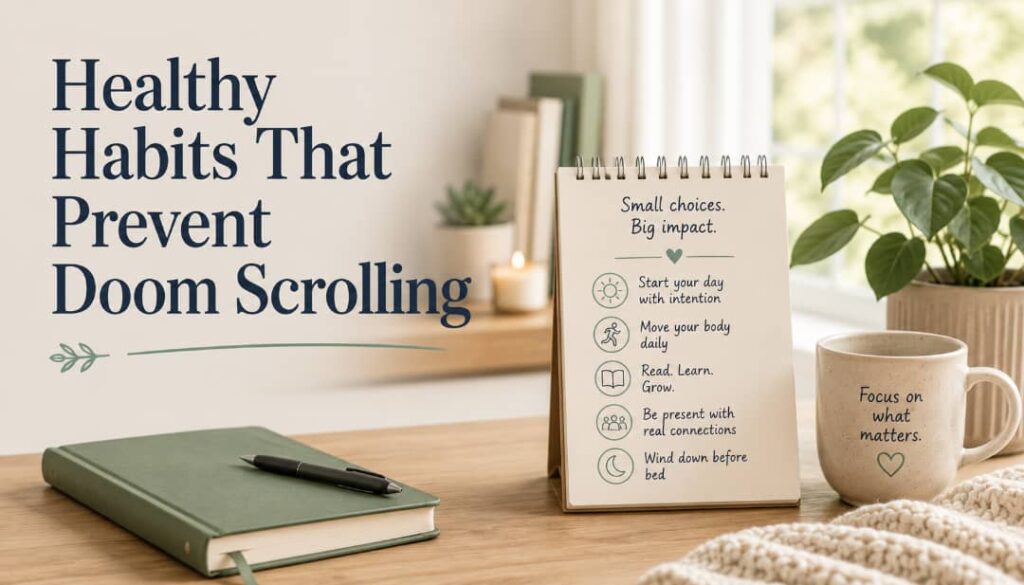
Stopping doom scrolling becomes easier when your life feels fuller offline.
That is why healthy routines matter.
Prioritize Real-Life Connection
Spend time with people physically and have meaningful conversations.
Laugh more offline.
Human connection reduces emotional dependence on social media.
Exercise Regularly
Physical movement improves mental clarity and reduces stress. Even simple walks can reduce the urge for excessive doom scrolling.
Build Offline Hobbies
Creative hobbies keep the mind engaged positively.
You can try:
- Reading
- Writing
- Cooking
- Photography
- Gardening
- Music
- Volunteering
Protect Your Mental Health
To boost your productivity, rest properly.
Take breaks.
Most importantly, set emotional boundaries online.
You do not need to consume every tragedy happening online to prove you care.
How Long Does It Take to Stop Doom Scrolling?
There is no perfect timeline.
For some people, small changes create quick improvement.
For others, breaking the doom scrolling habit takes longer.
What matters most is consistency. You do not need to become perfect overnight.
The goal is progress.
Some days you may still fall into excessive scrolling. That is okay. The important thing is becoming more intentional with your attention.
Frequently Asked Questions About Doom Scrolling
Doom scrolling refers to the habit of continuously consuming negative or stressful content online for long periods. It often happens on social media platforms, news websites, or video apps where users endlessly scroll through alarming headlines, emotional stories, and anxiety-triggering content.
Doom scrolling becomes addictive because social media platforms are designed to keep users engaged. Infinite scrolling, emotional content, and constant updates trigger the brain’s reward system. Fear of missing out also pushes many people to keep checking for new information.
Excessive doom scrolling can increase anxiety, stress, emotional exhaustion, and mental fatigue. Constant exposure to negative information can also affect sleep quality, concentration, mood, and overall emotional wellbeing.
One of the best ways to stop doom scrolling at night is by creating a bedtime routine without screens. Keep your phone away from your bed, set app limits, avoid social media before sleep, and replace nighttime scrolling with reading, journaling, or quiet relaxation.
There is no fixed timeline for overcoming doom scrolling. Some people notice improvement within days, while others may take weeks to build healthier digital habits. Consistency and intentional screen use are the most important factors.
Healthy alternatives include reading books, exercising, journaling, spending time outdoors, practicing mindfulness, learning new skills, and having real-life conversations. Replacing doom scrolling with meaningful activities helps reduce dependence on constant online stimulation.
Not always.
Many people successfully reduce doom scrolling by setting boundaries, curating their feeds, turning off notifications, and using social media more intentionally. The goal is balance, not necessarily complete disconnection
Final Thoughts on How to Stop Doom Scrolling
Your attention is one of your most valuable assets.
What you constantly consume shapes your thoughts, emotions, focus, and daily life.
That is why doom scrolling deserves serious attention.
The truth is that many people are mentally exhausted, not because they are physically overworked, but because their minds never truly rest.
There is always another headline, another notification and another endless scroll. But life is happening beyond the screen:
- Your goals deserve focus.
- Your relationships deserve presence.
- Your mental health deserves peace.
Learning how to stop doom scrolling is not about abandoning technology completely.
It is about creating a healthier relationship with it.

I’m Happiness Hassan, the founder of Inspiring Guide—A personal development blog that empowers you to become the best version of yourself!
Meet the Author
Happiness is also an SEO content writer and strategist with over 7 years of experience helping brands boost visibility, engagement, and sales.
Whether it’s keyword research, crafting content, or fine-tuning on-page and off-page strategies, I’ve got you covered. My goal is beyond driving traffic but making your users experience a win-win for everyone!
On the coaching side, I’ve trained countless writers to turn their passion into profitable SEO careers. I help them navigate the SEO path, standing out in even the toughest niches and cashing in on their skills.
When I’m not geeking out over SEO, you’ll find me deep in the world of self-development. As a dedicated student of continuous growth, I write about my growth journey, sharing insights to help others unlock their potential. So, if you’re looking for a little push to become your best self, stick around—I’ve got you covered!



0 Comments