
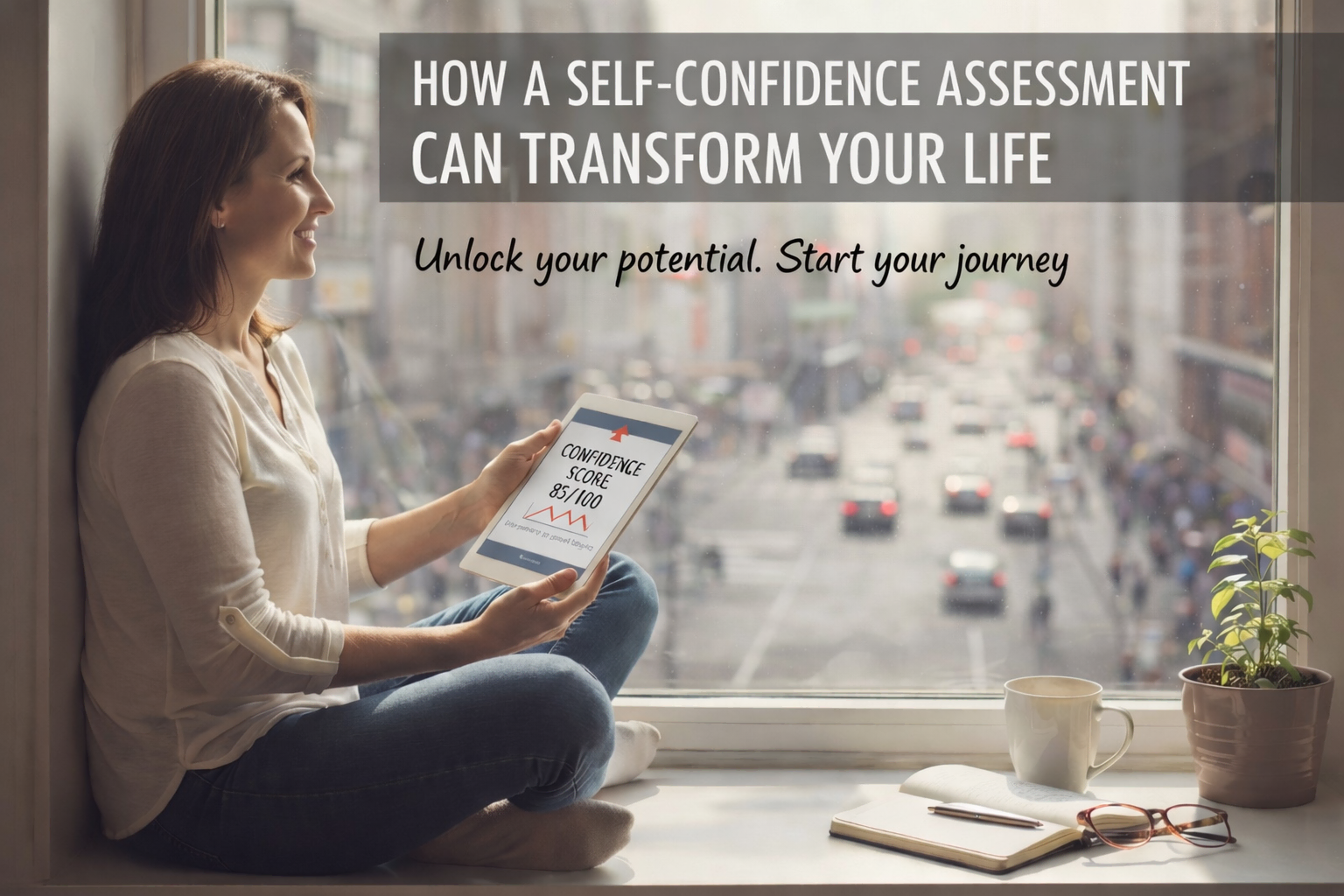
If you’ve ever stood on the edge of a big decision, you know the feeling. Maybe it was changing careers, starting a new relationship, or simply speaking up in a meeting.
If you’ve ever stood on the edge of a big decision, you know the feeling. Maybe it was changing careers, starting a new relationship, or simply speaking up in a meeting.
Just when you’re about to act, a cold wave of doubt creeps in and you think, “Who am I to do this?”
We’ve all been there!
But here’s the truth: transformation doesn’t start with a sudden burst of bravery. It starts with a quiet, honest look in the mirror.
A self-confidence assessment isn’t about labeling yourself broken or fixed. It’s about illumination. It’s about turning on the lights in a room where you’ve been stumbling in the dark, so you can finally see where the furniture is moved out of place.
If that sounds like you, keep reading.
Table of Contents
What is a Self-Confidence Assessment And Should You Take It?
At its core, a self-confidence assessment is a structured way to pause the noise of the world and check in with your internal compass. Most of us go through our days reacting to things—stress, criticism, praise without ever asking why we react the way we do.
Think of this assessment as a state of the union for your soul. It’s a dedicated space where you can answer questions honestly, away from the expectations of your boss, your partner, or your social media followers.
By taking the time to assess your current state, you can:
- Identify Confidence Anchors: Pinpoint exactly which areas of your life (like your career or your hobbies) make you feel grounded.
- Expose Confidence Leaks: Notice the specific triggers, perhaps social settings or financial discussions where your self-belief starts to drain away.
- Ditch the Comparison Trap: When you focus on your own data, you stop looking at others. If you struggle with this, our guide onhow to stop comparing yourself to others is a perfect companion piece to this assessment.
Self-Confidence Assessment Begins With Awareness
You might be wondering, “Can a simple assessment really change how I feel?” The answer lies in a psychological concept called Metacognition—or “thinking about your thinking.”
When we are stuck in a cycle of low self-esteem, our thoughts feel like absolute facts. We think, “I’m bad at public speaking,” and we believe it.
However, when you engage with a self-confidence assessment, you move from being the thought to observing the thought.
Suddenly, it’s not “I am bad at this.” It’s “I notice that I feel anxious when I haven’t prepared for a presentation.” That tiny shift in language is where your power lives. It turns an immovable mountain into a problem that can be solved with a bit of practice and the right mindset habits.
How to Use Your Self-Confidence Assessment Workbook
Let’s begin:
1. The 100 Reflective Questions
I’ve curated 100 questions that touch on every corner of your life. I ask about your social confidence, your professional self-assurance, and even your body neutrality.
These aren’t yes or no questions. They are invitations to rate your feelings on a scale, allowing you to see the nuances of your psyche.
2. The Power of the Journaling Pause
Every ten questions, we hit the brakes.
Why?
Because data without reflection is just numbers. This is where you get to use your favorite pen and just flow.
- What patterns am I noticing? (e.g., “I feel great at work but invisible at parties.”)
- Where is my inner critic loudest? What would my life look like if I felt 10% more capable in this area?
3. Growth Reflection Sections
These sections act as your debrief. After you’ve looked at the data, it helps you synthesize it. This is where the self-confidence assessment turns into an actionable plan.
Beyond the Assessment: Integrating Growth into Daily Life
Once you’ve finished your assessment, the real magic happens in the after. You can’t just put the workbook on a shelf and hope for the best. You have to take those insights and weave them into the fabric of your daily routines.
- Set Micro-Goals: If your assessment showed low confidence in social settings, don’t aim to give a keynote speech. Aim to ask one question in your next team meeting.
- Curate Your Environment: Your confidence is heavily influenced by who you surround yourself with. Are your friends lifting you up or subtly bringing you down? Check out our guide onsetting healthy boundaries in friendships for more on this.
- Celebrate the Small Wins: We often wait for the big promotion to feel proud. Start celebrating the fact that you hit the gym or finally made that difficult phone call.
Confidence Is a Journey, Not a Destination
The most important thing to remember is that self-confidence assessment is a tool for a lifelong journey.
There is no perfect score. There is no finish line where you will suddenly never feel doubt again. Even the most successful people in the world—the CEOs, the artists, the leaders we admire, have moments where they feel like a total fraud.
The difference? They have the tools to navigate those feelings. They know how to assess the doubt, acknowledge it, and move forward anyway.
Download our free self-confidence assessment workbook to get started.

I’m Happiness Hassan, the founder of Inspiring Guide—A personal development blog that empowers you to become the best version of yourself!
Meet the Author
Happiness is also an SEO content writer and strategist with over 7 years of experience helping brands boost visibility, engagement, and sales.
Whether it’s keyword research, crafting content, or fine-tuning on-page and off-page strategies, I’ve got you covered. My goal is beyond driving traffic but making your users experience a win-win for everyone!
On the coaching side, I’ve trained countless writers to turn their passion into profitable SEO careers. I help them navigate the SEO path, standing out in even the toughest niches and cashing in on their skills.
When I’m not geeking out over SEO, you’ll find me deep in the world of self-development. As a dedicated student of continuous growth, I write about my growth journey, sharing insights to help others unlock their potential. So, if you’re looking for a little push to become your best self, stick around—I’ve got you covered!


0 Comments